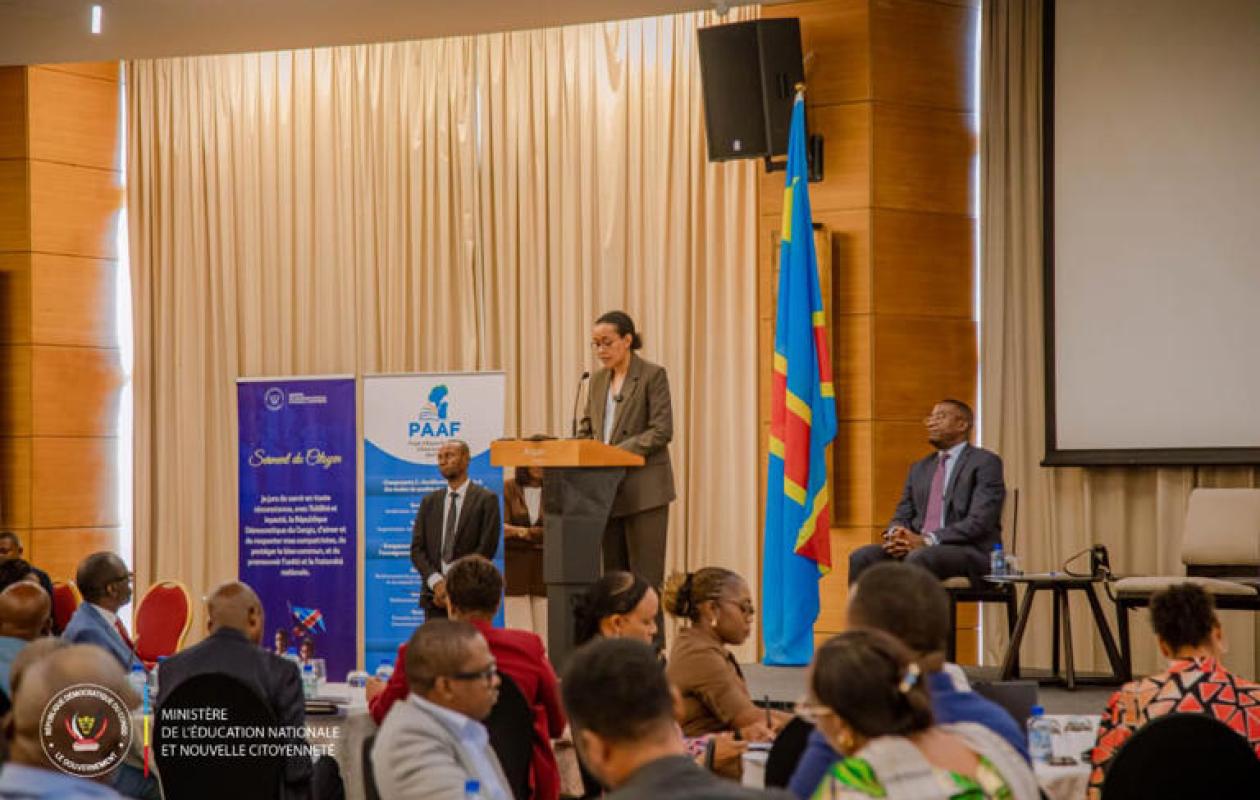
RDC : Un "moment de vérité" pour le projet PAAF dédié à l'éducation des filles
On Monday, May 11, 2026, the Congolese capital throbbed to the rhythm of the mid-term review of the Girls' Learning and Empowerment Project ( PAAF ). Chaired by the Minister of State for National Education and New Citizenship, Raïssa Malu , this meeting marks a decisive turning point for this large-scale program endowed with $400 million .
Far from the usual formalities, Raïssa Malu established a tone of rigor. Facing experts and partners (including the World Bank), she demanded a frank analysis of the first two years of implementation.
"People are not expecting accounting adjustments, but tangible results," she insisted.
The objective is clear: to identify administrative and logistical obstacles in order to transform the project's ambitions into concrete realities in the ten targeted provinces.
Funded by the World Bank, the PAAF does not just provide one-off assistance; it aims for a profound transformation of the education system by December 2028.
The project is being deployed in key areas, including the Kasai region, South Kivu, Ituri, Kinshasa, Kongo-Central, Kwilu, Lomami and North Kivu.
The Minister particularly emphasized two points of concern:
Beyond 2028, the Congolese government hopes that the innovations of the PAAF — such as the digitization of teaching materials and the training of inspectors — will become the norm throughout the territory.
This review, in which the Minister of State for Planning, Guylain Nyembo , also participated, is part of the DRC's five-year vision for 2024-2029. The ultimate goal remains to build an inclusive education system where every girl, regardless of her province, has the tools to succeed in her secondary education.



















Commentaires (0)
Participer à la Discussion
Règles de la communauté :
💡 Astuce : Utilisez des emojis depuis votre téléphone ou le module emoji ci-dessous. Cliquez sur GIF pour ajouter un GIF animé. Collez un lien X/Twitter, TikTok ou Instagram pour l'afficher automatiquement.