Esclavage: Macron soutient l'abrogation du "Code noir" et évoque la question sensible des "réparations"
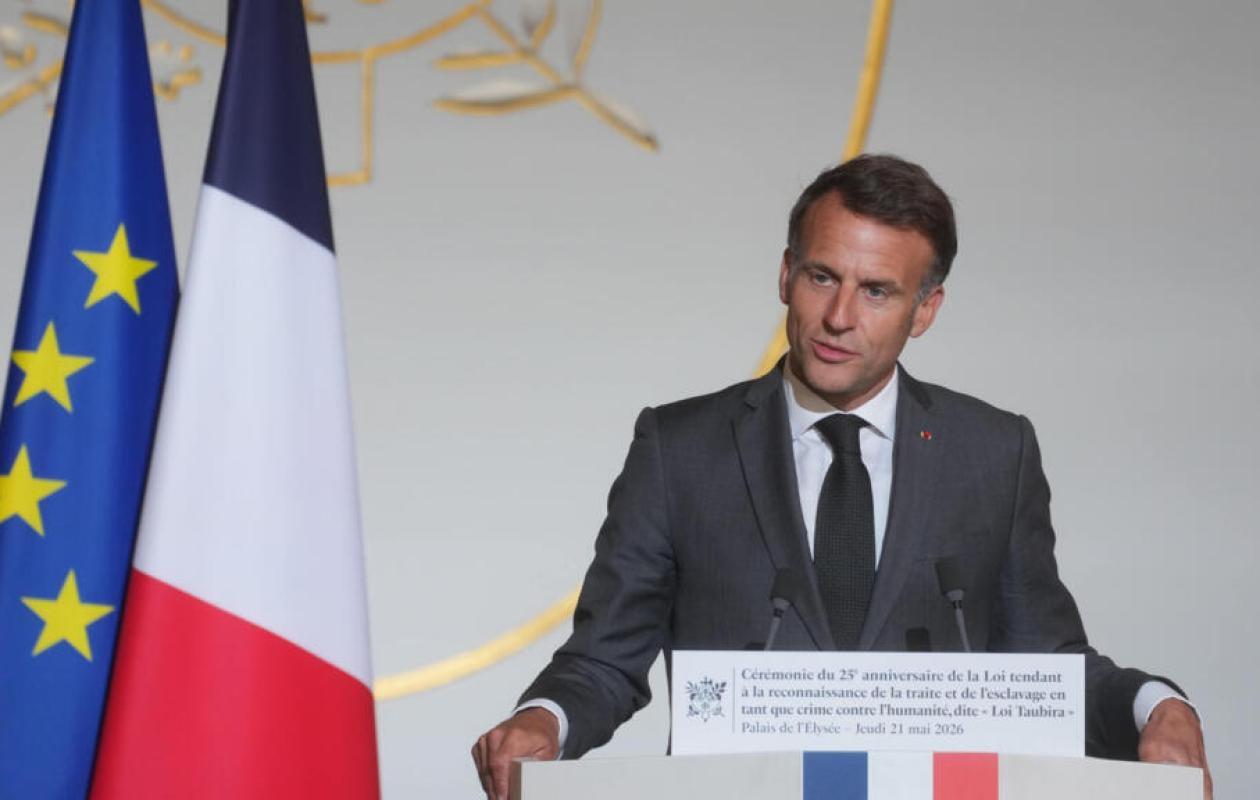
Emmanuel Macron on Thursday supported the symbolic repeal of the "Black Code", initiated by Parliament, and spoke at length about his "unfinished" reflection on the sensitive issue of "reparations" for slavery, which in his view begin with "recognition" and can never be "total".
During a reception at the Elysée Palace for the 25th anniversary of the law recognizing the slave trade and slavery as a crime against humanity, the head of state paid tribute to a "necessary" text and to its author, Christiane Taubira.
He referred to another text, the "Code noir", the name given to a set of royal edicts dating from the 17th and 18th centuries organizing slavery and never formally repealed, the maintenance of which, even without legal effects, "has become a fault", "a form of offense", "a betrayal of what the Republic is".
"That is why I am asking the government to adopt the bill to repeal the Black Code, which is to be debated on May 28 in the National Assembly," he said regarding this repeal which was already unanimously adopted in committee on Wednesday.
Also present, Christiane Taubira for her part mentioned the resolution adopted at the end of March by the UN General Assembly, at the initiative of Ghana, which makes slavery and the trafficking of Africans "the most serious crimes against humanity".
France, along with other European countries, abstained, on the grounds that it does not want a hierarchy between crimes against humanity, a position assumed on Thursday by Emmanuel Macron.
The former Minister of Justice, for her part, stressed that it had been massively adopted by countries in Africa, Latin America and the Caribbean, "which also recognize the futility of the hierarchy between crimes against humanity".
"We cannot ignore what lies behind this, which is precisely a demand for justice, always for reparation," the head of state acknowledged.
He announced the launch, with Ghana, of an "international scientific work" to "make very concrete recommendations to political decision-makers", without saying precisely whether these would be recommendations on possible reparations.
Emmanuel Macron also added that "repair", a "huge question", should not be avoided.
"But this is also an issue on which we must not make false promises," he warned. "We must be honest with ourselves and admit that we can never fully undo this crime, because it's impossible," "you will never be able to put a number, a word, on it that would bring this story to a close."
He himself asserted that his "reflection" and "decisions" on the subject were "still incomplete".
He recalled that he had launched a year ago a project by historians to assess "the price" of freedom imposed by France on Haiti, which will be presented to him in December.
"To repair is first and foremost to restore the rightful place" of the facts "in the history of the Republic," which requires education, he argued.
"But this is not a light gesture. And we have not finished this journey of recognition," he insisted.
"If we do not acknowledge, there is no chance that we can build the future," he added, referring to those, particularly on the right or far right, who regularly criticize gestures of "repentance."
"There is no French identity, neither in the denial of what has been done (...) nor in the refusal to move forward on recognition or reparations," Emmanuel Macron insisted, before continuing, also addressing the radical left: "nor in the exclusive retreat to these stories where others would like to promise that the possible reparation is complete, or that the real struggle is in a contemporary communitarianism."
"That's why we will always have the imperfect repair," he warned.












Commentaires (0)
Participer à la Discussion
Règles de la communauté
💡 Astuce : Utilisez des emojis depuis votre téléphone ou le module emoji ci-dessous. Cliquez sur GIF pour ajouter un GIF animé. Collez un lien X/Twitter, TikTok ou Instagram pour l'afficher automatiquement.
Se connecter
Commentez avec votre profil, votre photo, et soyez averti des réponses.